

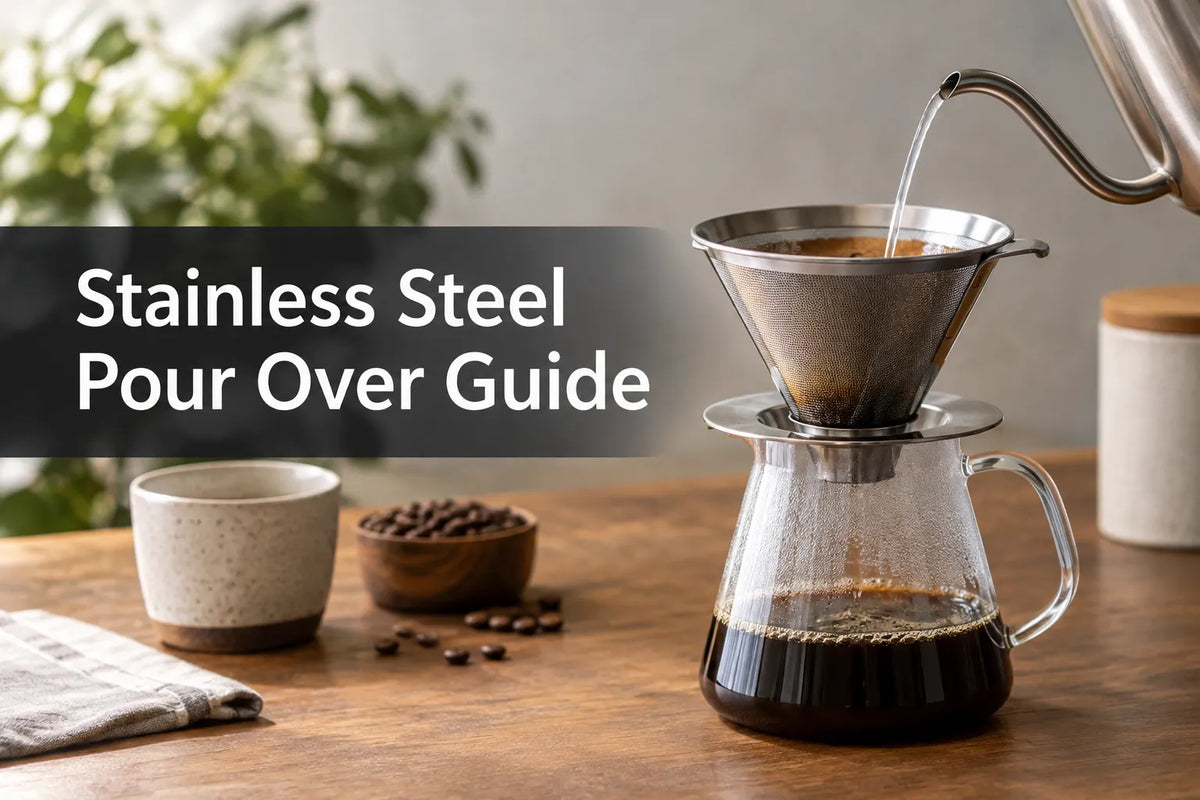
Want a pour over coffee maker with stainless steel filter? Expect a sturdy, reusable setup and a fuller-bodied cup. For cleaner flavor separation and faster cleanup, choose a steel dripper that takes paper. A metal body does not require a metal filter, even when the two arrive together.
Think about the cup you like and the cleanup you can tolerate before choosing a brewer for your counter, travel bag or gift.
What does “stainless steel” mean on a pour-over box?
A “stainless steel pour over coffee maker” could refer to any of these parts:
Steel dripper: The cone or basket holding the grounds. It may require a paper filter, come with a reusable metal insert or work with both.
Stainless steel filter: A perforated or mesh basket that replaces disposable paper. You can also find standalone filters intended to fit a separate brewer.
Steel carafe or server: The vessel receiving the coffee. A stainless steel pour over coffee pot is not necessarily a metal-filter brewer.
Line a steel V60-style dripper with paper and you get paper-filtered coffee. Fit a glass carafe with stainless mesh and you get metal-filtered coffee. The brewer’s outer material cannot tell you which cup to expect.
Look at the included filter before you buy: can you remove it, and can you use paper if you want to? The dripper should sit securely on your mug or server, while a carafe set needs enough room for the batch you usually make.
Pour over coffee maker with stainless steel filter: mesh or paper?
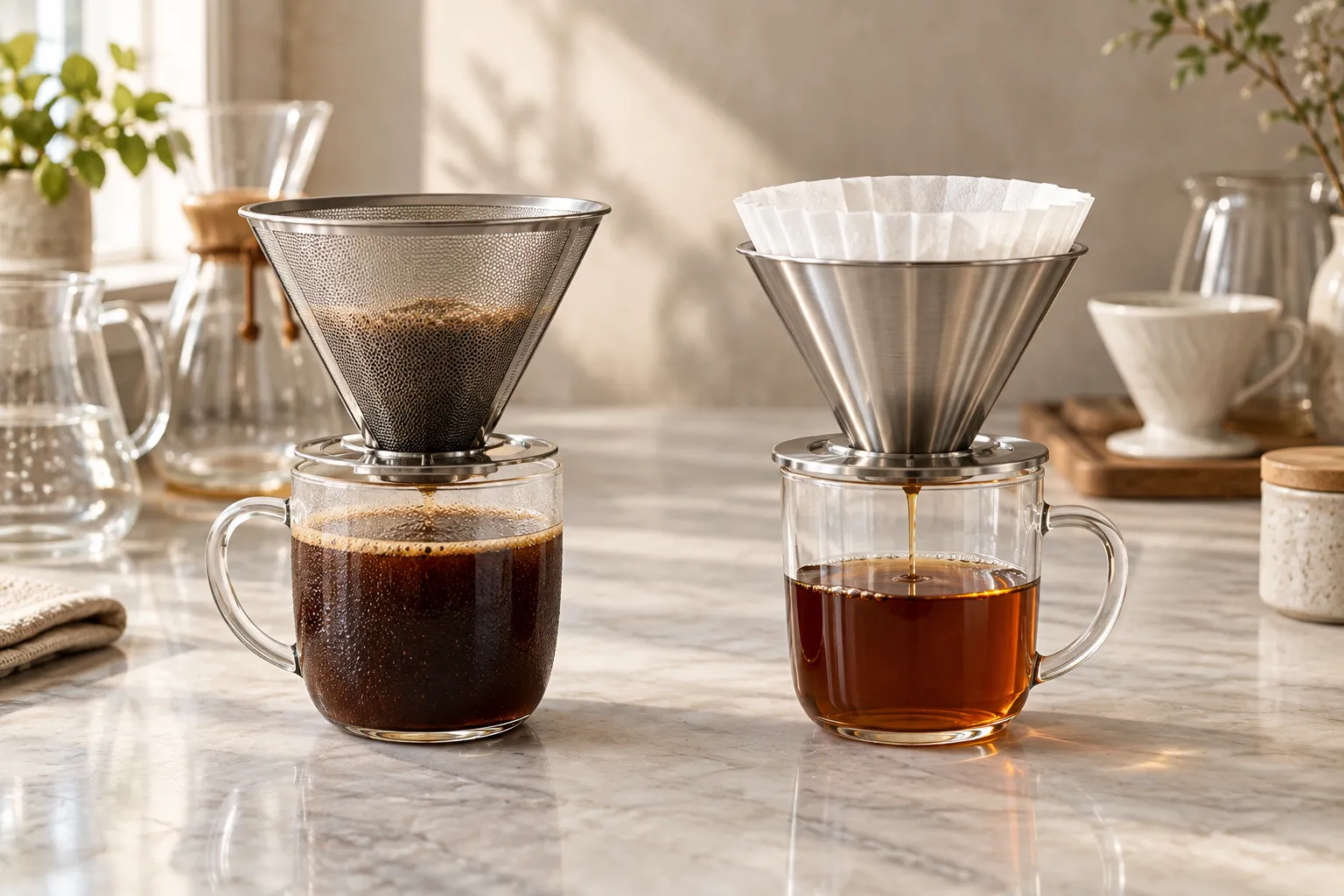
Metal mesh lets more coffee oils and fine particles into your cup, giving it a rounder, heavier texture and sometimes sediment in the last sip. Paper catches more oils and fines for a clearer, lighter drink. Grind and pouring technique still count with either filter.
Choice |
Reusable stainless mesh |
Paper inside a steel dripper |
|---|---|---|
Cup |
More body and oils; possible fine sediment |
Cleaner texture and clearer separation of flavors |
After brewing |
Knock out grounds and wash the mesh |
Lift out and discard the used paper and grounds |
Ongoing supplies |
No disposable filter needed |
Buy paper in the correct size and shape |
Better fit |
Someone who likes a richer cup and accepts washing |
Someone who values clarity and quick cleanup |
A fine, double-layer mesh may catch more particles than a coarse perforated filter. You may still find sediment in a paperless cup. For the crisp character of a washed, light-roast coffee, try a stainless pour over coffee dripper that takes paper. A reusable insert suits you better if you like a heavier cup and prefer not to restock filters.
The difference is not purely sensory: paper also retains more coffee diterpenes. In a randomized study of boiled coffee, the group drinking it without paper filtration had higher LDL cholesterol than the group drinking the same coffee after paper filtration. That study did not compare every kind of pour-over mesh, so it should not be read as a measurement of your particular brewer.
"LDL cholesterol was 0.41 mmol/L higher in the group drinking boiled coffee than in the group drinking boiled coffee passed through paper." - Arteriosclerosis and Thrombosis study
Some metal-filter setups also accept paper, provided the paper fits without blocking the outlet. A permanent filter and a paper-lined dripper do not necessarily work the same way.
Stainless steel vs glass and ceramic
Brewer material changes how you handle heat; the filter has the more direct effect on texture. Metal warms quickly under hot water and transfers heat to its surroundings. A heavy ceramic cone takes more energy to warm, so preheating helps you brew consistently. You can watch coffee drain through glass, though glass is vulnerable to knocks. Pouring technique still matters with all three.
Brewer material |
Practical advantage |
Tradeoff |
Best setting |
|---|---|---|---|
Stainless steel |
Impact-resistant and often light enough to pack |
Exterior gets hot; a thin brewer can shed heat |
Travel, small kitchens, busy counters |
Glass |
You can see the coffee drain; visually airy on a counter |
Breakable and often needs preheating |
Home brewing and serving |
Ceramic |
Substantial feel and many decorative finishes |
Heavy, breakable and slow to warm when cold |
A permanent home station or display-worthy gift |
With any of these, a preheated server helps keep the finished drink warm. A steel dripper is not an insulated travel mug, and a steel carafe is not automatically insulated either. If heat retention after brewing is your priority, look at the receiving vessel as well as the dripper.
At home, steel with paper gives you a durable dripper without changing your preferred cup style. Glass and ceramic look good on an open shelf, though both need more care in a crowded sink or suitcase. Pick your filter first; then choose the body that fits your space.
Cone-shaped vs flat-bottom drippers
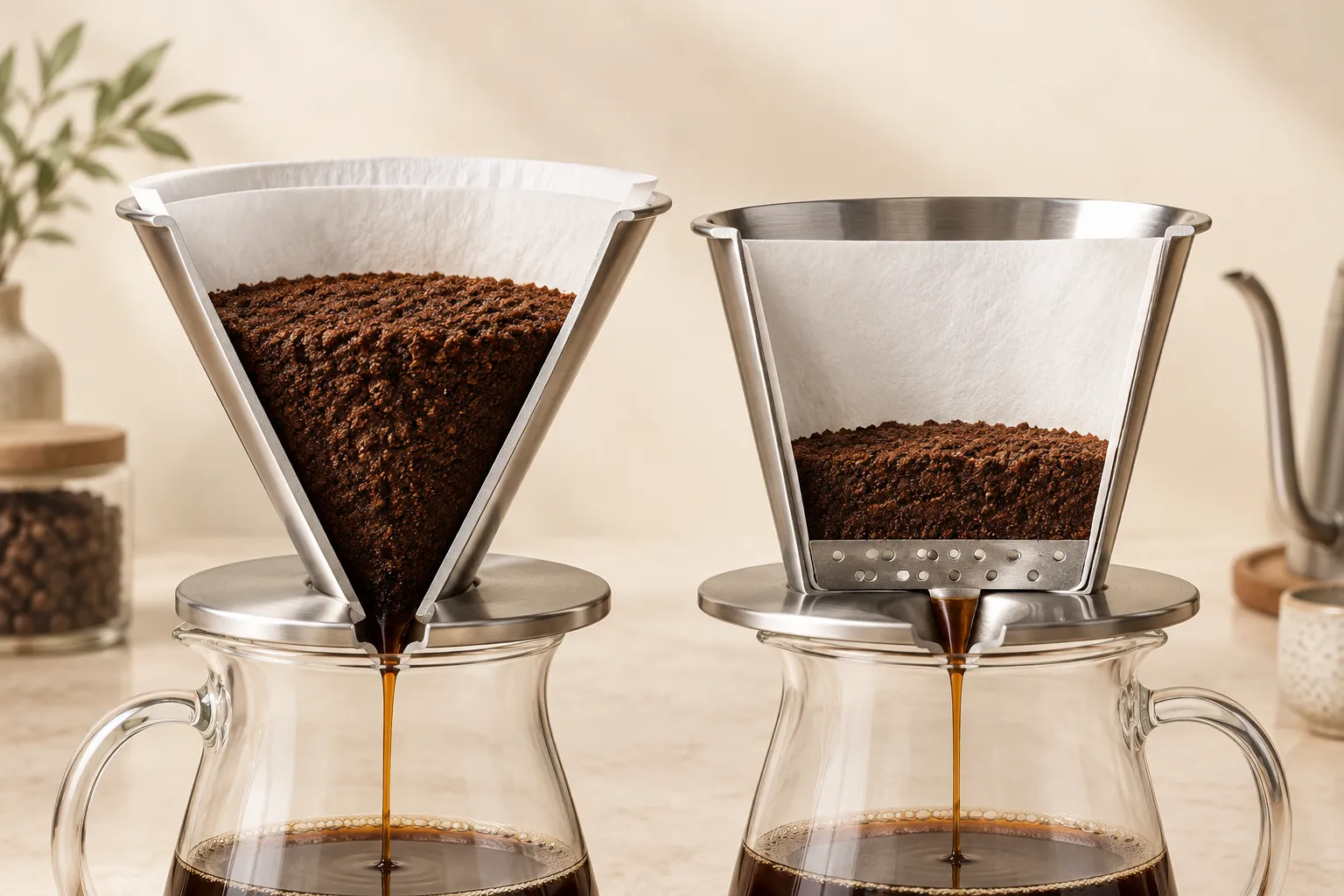
You can find cone-shaped and flat-bottom drippers in different materials. A cone narrows to one outlet and usually takes a cone filter. A flat-bottom brewer holds the coffee grounds across a wider base and drains through one or more holes. Filter type, grind and drain holes all affect brew time; plan to adjust the grind when you change shapes, even with the same coffee beans. The shape alone does not guarantee a better cup or one with more acidity.
How to choose a steel setup for home, travel or a gift
For the everyday home brewer
If you do not mind rinsing mesh after breakfast, a reusable stainless filter saves you from buying paper. If you brew before heading out the door, a steel cone that takes paper may be easier to live with. Check the base against your favorite mug, and keep an eye on the liquid level as you pour into an opaque cup.
If you already own a glass server, you do not need to replace it to try a steel dripper. A glass-and-metal-filter set makes sense when you want to serve directly from its carafe, but it is not an all-steel brewer. For scale, Ovalware lists a 500 ml/17 oz glass pour-over maker with a reusable stainless filter. That is a carafe set for a small batch, not a steel pot you can pack without care.
For travel
A compact steel dripper can go into a bag without the worry of a shattered cone. Mesh saves space otherwise taken by spare papers, though you will have to empty wet grounds and wash the filter. In a hotel room, a paper-compatible steel cone could be tidier. Match its base to your travel mug and protect a sharp rim in your bag.
For gifting
If your recipient has a favorite paper-filter recipe, look for a steel brewer that takes the paper they use. Someone who likes a rich cup and few consumables may appreciate a steel-filter set. A glass carafe looks lovely when serving, provided the recipient has space to store and wash a breakable vessel.
Do not confuse a kettle with a pour-over pot or dripper. The dripper holds the coffee; a gooseneck kettle controls where and how quickly water lands. Cocinare’s Artisan Collection suits a design-minded home brewer, while its Color-changing Collection offers a more expressive gift. These gooseneck kettles complement a steel, glass or ceramic brewer when precise pouring is part of the gift. They are not a substitute for the brewer or its filter.
The short buying checklist
Before choosing the best stainless steel pour over coffee maker for your routine, look for:
Filter format: Permanent mesh, paper-compatible cone or both, with the compatible paper shape stated clearly.
Stable fit: A base that sits securely on the mug or server you use.
A workable batch size: Enough room for your usual grounds and pours, without buying a large set for one small cup.
Cleanable construction: A mesh you can reach on both sides and a removable insert that lets you clear trapped grounds.
Comfortable handling: A safe place to grip a hot dripper, and a carafe that is easy to pour and wash if included.
These details tell you more than the words “stainless steel” on a product listing.
Brewing and cleaning with a reusable steel filter
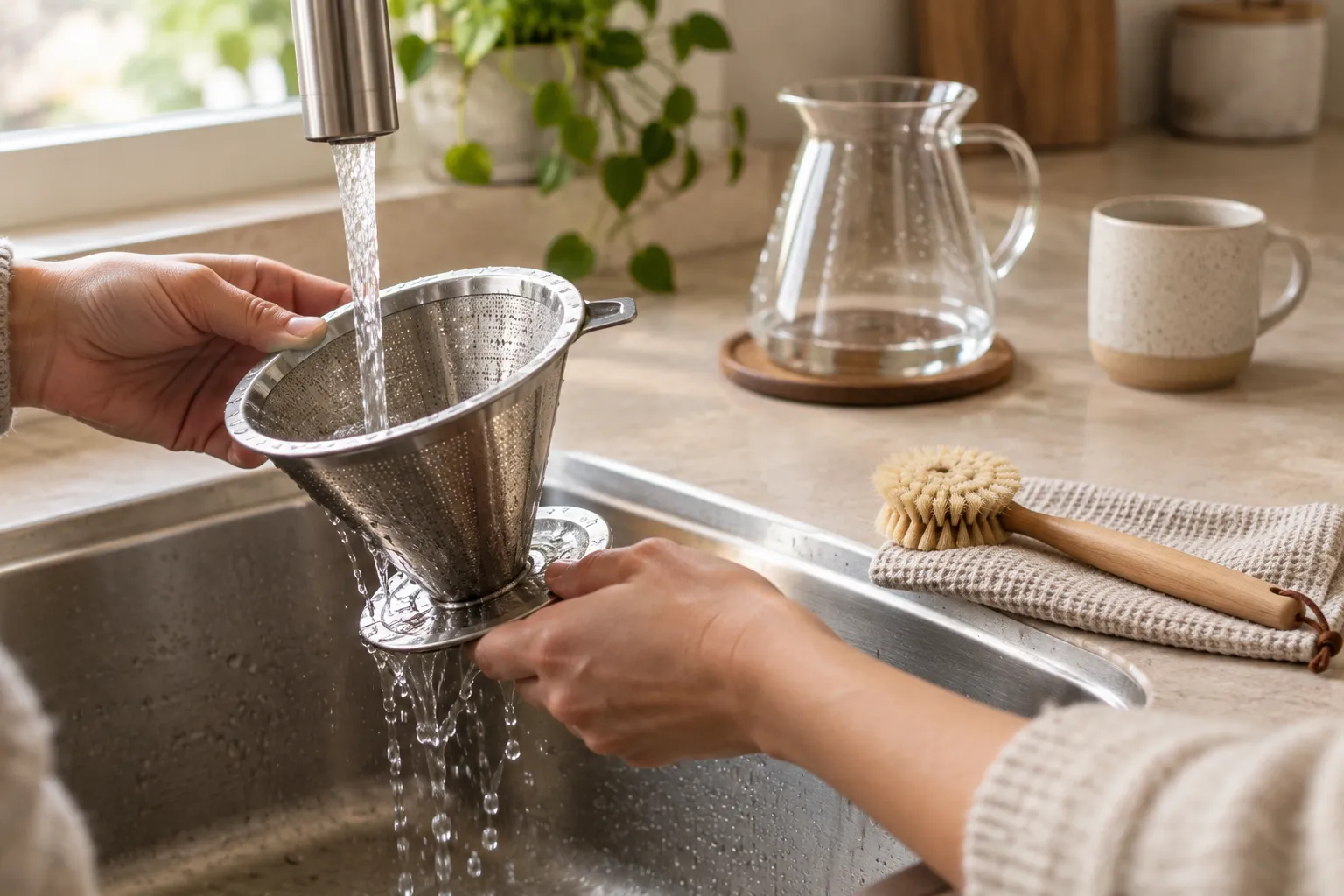
Start with a medium grind and 20 g coffee to 320 g water. Set the mesh on a stable cup or server, rinse with hot water and discard the rinse water. Add your grounds and wet them evenly with a small pour. After they bloom, pour gently enough to keep the bed wet without flooding the rim. Taste the finished cup before adjusting your recipe.
If the cup tastes thin and sharp, grind a little finer or pour more slowly. If drainage drags or the cup tastes harsh, try a coarser grind and check for fines caught in the mesh. Do not expect the same grind setting to behave identically in paper and steel: changing the filter changes both flow and texture.
Once the filter has cooled, empty the grounds and rinse it from both sides. Wash it as the maker directs and let it dry fully before storing it. A soft brush can clear oils or fines from the openings; a metal tool could distort the mesh. Paper simplifies disposal, while mesh trades a little washing for freedom from repeat filter purchases.
The verdict
Buy a pour over coffee maker with stainless steel filter if you like a weightier cup, want a reusable filter and are willing to wash it. Choose a paper-compatible steel dripper if durability matters more to you than going paperless. Choose glass or ceramic when the way a brewer looks and feels at home outweighs portability, and allow time to preheat it.
Whichever body you select, controlled pouring makes the daily brew easier to repeat. Pair your brewer with a Cocinare gooseneck kettle if you want precise water placement and a design-forward piece that belongs on the counter beside it. Cocinare offers free standard shipping within the contiguous United States, 30-day returns and a limited warranty of up to 18 months.
FAQ
Are stainless steel pour-over coffee filters good?
Yes, if you prefer a fuller-bodied cup and want to reuse the filter. Stainless mesh lets more oils and some fine sediment through than paper, and you need to wash it after each brew.
Is there a stainless steel pour-over coffee maker?
Yes. You can buy a steel dripper that uses paper, a steel dripper with a reusable mesh insert, or a carafe set with a metal filter. Read the filter specification rather than assuming every steel brewer is paperless.
What is the best stainless steel pour-over coffee filter?
The best fit is a filter that sits securely in your brewer, drains without stalling and is easy to clean. A finer mesh may reduce visible grounds, but paper is the better choice if you want the clearest cup.
What is the best material for a pour-over coffee maker?
Stainless steel suits a durable, portable setup; glass lets you watch the brew; ceramic has a heavier, decorative feel. Filter choice and a steady pouring technique matter more to the cup than the body material alone.
Is ceramic pour over better than stainless steel?
Not across the board. Ceramic suits a stationary, display-worthy home setup, but it is heavier and breakable; steel is more practical for travel and frequent handling. Preheat a cold ceramic dripper before brewing for more consistent heat.
Share:
Breville Barista Express Portafilter Size Guide
What Is a V60 Coffee Maker?