

Espresso Machine for Home: Best Types to Know
If you’re shopping for an espresso machine for home, the hardest part usually isn’t finding a machine. It’s figuring out which type actually fits your life.
Some people want a quick, easy morning flat white with minimal cleanup. Others want the ritual: weighing beans, dialing in the grind, steaming silky milk, and slowly building café-level skill at home. And then there’s everyone in between - people who want beautiful design, serious performance, and a machine that feels good to live with on the counter every day.
That’s where this guide comes in.
Rather than throwing dozens of models at you, we’ll help you understand the best home espresso machine categories, what each one does well, where each falls short, and how to choose based on your drinks, space, budget, and workflow. We’ll also cover why the grinder matters so much, when it makes sense to go compact, when to invest in a high end espresso machine for home, and how a well-designed brewing setup can turn coffee into a daily ritual rather than a rushed task.
At Cocinare, we care deeply about that ritual. While espresso may be the focus here, the same values apply across specialty coffee: precision, durability, tactile pleasure, and design you actually want to see in your kitchen. Whether you’re pulling shots or perfecting a pour-over with a precision gooseneck kettle, better coffee starts with tools that feel intentional.
"In 2025, the at-home coffee market in the United States generated approximately $90 billion in revenue." - Statista
What the Best Competitor Guides Get Right - And What They Miss
After reviewing leading espresso content from top-ranking publishers and specialty coffee sites, a few patterns stand out.
What they do well
Most strong guides agree on a few essentials:
Machine type matters more than brand hype
The grinder is as important as the machine
Espresso involves trade-offs between convenience and control
Bambino, Gaggia Classic, Bianca, and Dual Boiler-style machines dominate serious recommendations
Buyers need different answers depending on whether they want espresso, milk drinks, or low-effort convenience
The content gaps we’re closing here
Many competitor posts still leave a few important questions underexplained:
They compare models without clearly explaining lifestyle fit.
Readers often leave knowing which machine is “good,” but not which one suits their kitchen, taste, and routine.They underplay aesthetics and countertop experience.
For design-conscious home brewers, the best coffee and espresso machine for home isn’t just about shot quality. It’s also about how the machine fits the space and enhances the ritual.They focus heavily on espresso alone.
In real homes, many coffee lovers move between espresso, milk drinks, and pour-over. A more complete setup story matters.They don’t always account for the full ecosystem cost.
Machine, grinder, scale, tamper, milk pitcher, water setup, cleaning gear - these all affect the actual buy-in.They rarely talk about emotional usability.
Some machines are technically excellent but frustrating to own. Others are slightly less “pure” but much easier to love daily.
That’s why this guide focuses not only on machine specs, but on the entire home coffee experience.
The Five Main Types of Home Espresso Machines
Before comparing specific price tiers or styles, it helps to understand the big categories.
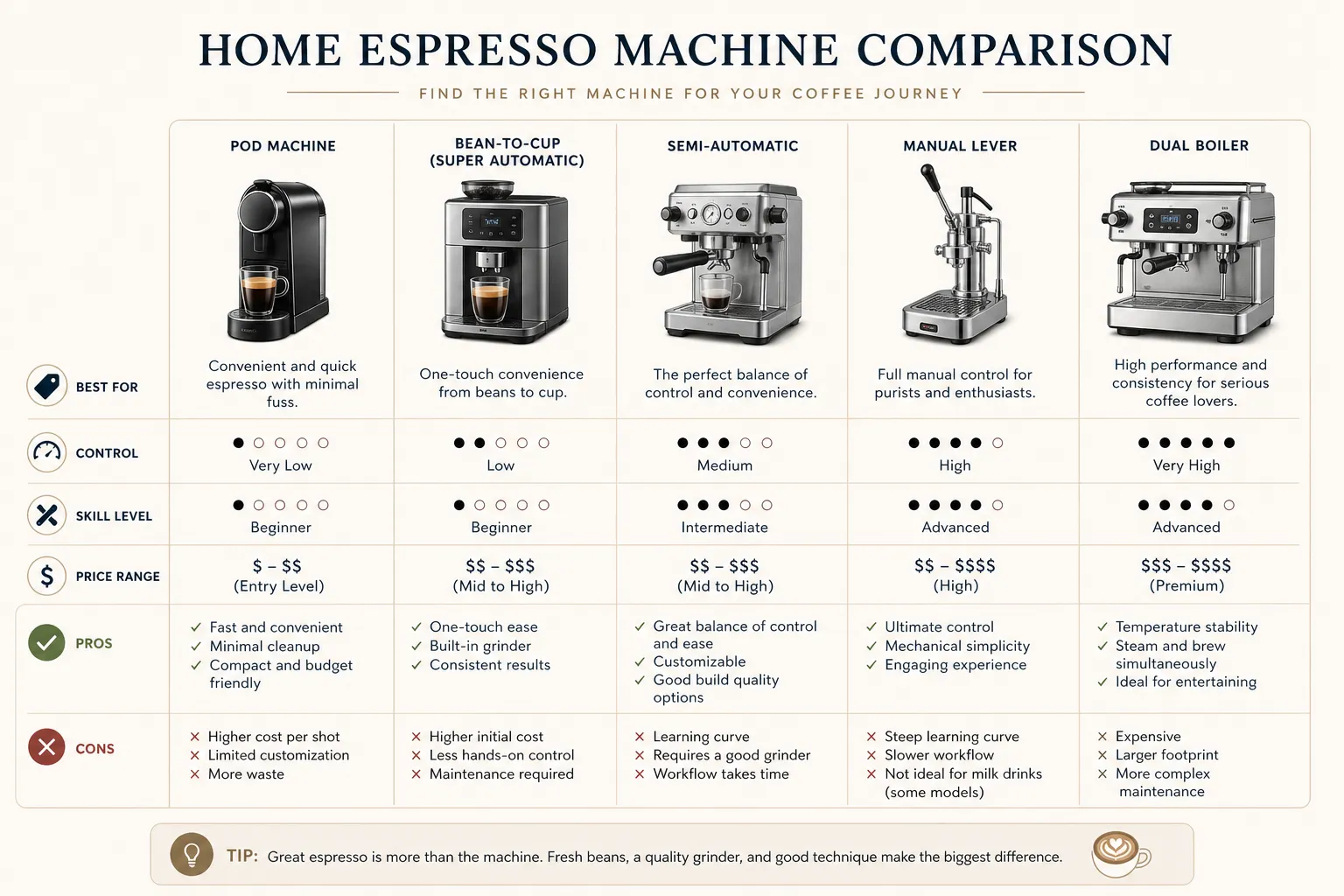
Quick comparison table
Type |
Best for |
Pros |
Trade-offs |
|---|---|---|---|
Pod / capsule |
Convenience-first users |
Fast, clean, small footprint |
Lower flavor ceiling, pod cost, less control |
Bean-to-cup automatic |
Busy households |
One-touch drinks, integrated grinder |
Less espresso depth, limited steaming finesse |
Semi-automatic with grinder |
Aspiring home baristas |
Great balance of control and simplicity |
Still requires practice and cleanup |
Traditional manual / prosumer |
Enthusiasts |
Highest espresso potential |
Bigger learning curve, separate grinder required |
Manual lever |
Purists and tinkerers |
High control, tactile workflow |
Slow, niche, not ideal for milk-heavy routines |
Type 1: Pod Machines for Home
Best for: speed, simplicity, and minimal cleanup
A Nespresso machine for home is often the easiest path into espresso-style drinks. If your priority is getting a coffee with almost no effort, pod systems make sense.
Why people choose them
Small footprint
Consistent results
Very fast heat-up
Minimal mess
Great for guest rooms, offices, or occasional espresso drinkers
Where they fall short
Per-cup cost is high
Environmental footprint depends on recycling habits
Espresso is usually more “espresso-like” than true café-quality espresso
Limited control over dose, grind, and extraction
Who should buy one
A pod machine works well if you want an easy espresso machine for home and don’t want coffee to become a hobby. If your benchmark is convenience, a capsule machine can be a smart buy. If your benchmark is café-style flavor and milk texture, it’s usually a stepping stone, not a destination.
Type 2: Bean-to-Cup Automatic Espresso Machines
Best for: households that want one-touch coffee from whole beans
If you want an automatic espresso machine for home that still uses fresh beans, bean-to-cup machines sit in a very attractive middle ground.
They grind, dose, brew, and often froth milk with one or two button presses. For many households, that convenience is worth the trade-off.
Strengths
Fresh beans rather than pods
Easy for multiple users
Great for lattes, cappuccinos, and long coffees
Often includes user profiles and automatic cleaning cycles
Limitations
Espresso can be lighter-bodied than on a semi-automatic or professional coffee machine for home
Built-in grinders are rarely elite
Milk systems are convenient, but not usually barista-grade
Repairs can be complex if grinder and brewer are deeply integrated
Ideal buyer
Bean-to-cup is perfect if you want espresso makers for home that prioritize speed and simplicity, but still feel more premium than capsules. If you host often, share the machine with less coffee-obsessed family members, or just want one-touch coffee before work, this category is worth serious attention.
Type 3: Semi-Automatic Machines With Integrated Grinder
Best for: people who want real espresso without going fully nerdy
This is one of the most compelling categories for modern buyers. A semi-automatic machine with a built-in grinder gives you a more authentic workflow - fresh grinding, real portafilter prep, proper milk steaming - without forcing you to buy every piece separately on day one.
Why this category wins so often
It’s the sweet spot between convenience and craft.
You get:
Better espresso potential than bean-to-cup
Less setup complexity than separate machine + grinder
A more immersive barista experience
Strong value for design-conscious kitchens with limited space
The catch
Integrated grinders are convenient, but often not as upgradeable or as precise as dedicated grinders. If you suspect this hobby might escalate, separate components offer more long-term flexibility.
Ideal buyer
If you want the best espresso machine for home use without turning your counter into a science lab, this is often the most balanced category.
Type 4: Traditional Manual and Prosumer Machines
Best for: enthusiasts who want the highest espresso quality at home
This is where espresso gets serious.
Traditional machines let you control grind, dose, shot timing, and milk texture. Many of the most respected recommendations for the best home professional espresso machine live here: machines from Lelit, ECM, Profitec, La Marzocco, and similar brands.
Why people love them
Highest flavor ceiling
Better steaming power
More serviceable and longer-lived designs
Standard 58 mm ecosystems on many models
Better pairing with high-end grinders
Why they aren’t for everyone
Separate grinder required
More counter space needed
More maintenance and skill
Heat-up times can be longer
Total cost rises quickly
Best fit
Choose this route if espresso itself is the hobby, not just the beverage. If you dream of café-style flat whites, care about shot profiling, or want a professional espresso machine for home, this is likely where you’ll end up eventually.
Type 5: Manual Lever Machines
Best for: purists, tinkerers, and ritual-first brewers
Manual lever machines are the most hands-on category. They can produce remarkable espresso, but the workflow is slower and more involved. They’re loved by enthusiasts who enjoy full tactile control and don’t mind a niche routine.
Pros
Compact in some cases
Deep control over extraction
Beautiful, mechanical brewing ritual
Often great value if you already own a strong grinder
Cons
Not ideal for back-to-back milk drinks
Learning curve is steep
Less practical for households with multiple users
Workflow is more demanding than pump machines
For the right person, this can be the best manual espresso machine for home. For most buyers, it’s a second-machine passion purchase rather than the obvious first choice.
How to Choose the Right Espresso Machine for Your Home
Start with the drinks you actually make
This is the most important question.
If you mainly drink... |
Best machine types |
|---|---|
Straight espresso |
Semi-auto, prosumer, manual lever |
Flat whites / cappuccinos |
Semi-auto, dual boiler, prosumer |
Lattes with minimal effort |
Bean-to-cup or capsule + frother |
Americanos / long blacks |
Bean-to-cup, semi-auto, prosumer |
Mixed household drinks |
Bean-to-cup or semi-auto with grinder |
A lot of people shop by machine category when they should really shop by daily drink behavior.
Then consider your tolerance for workflow
Ask yourself honestly:
Do you want to weigh beans every morning?
Are you happy steaming milk manually?
Will you clean a portafilter and wand after every use?
Do you enjoy learning through trial and error?
If yes, you’ll be happier with a good home espresso machine that gives you control. If no, convenience should carry more weight in the decision.
Space matters more than people admit
A small espresso machine for home can be a lifesaver in apartments or minimalist kitchens. But compact machines also come with trade-offs:
Smaller water tanks
Tighter cup clearance
Less workspace around the drip tray
Sometimes weaker steaming
If counter space is precious, think in terms of whole setup footprint, not just machine width.
Why the Grinder Matters So Much
Most expert competitors agree on this, and they’re right: your grinder can make or break espresso.
"Espresso is defined as a 25–35ml beverage prepared... with clean water of 195°–205°F forced at 9–10 atmospheres of pressure, with a brew time of 20–30 seconds." - Specialty Coffee Association
That kind of precision is impossible if your grind size is inconsistent or can’t go fine enough.
What a proper espresso grinder needs
Fine enough grind range for espresso
Small adjustment steps
Consistent particle size
Good retention management
Reliable workflow
Should you buy separate or integrated?
Setup |
Better for |
|---|---|
Integrated grinder machine |
Simplicity, smaller spaces, first setup |
Separate espresso grinder for home |
Better long-term value, stronger performance, upgrade flexibility |
If you’re building a dedicated station, a separate espresso grinder for home often gives better results and more room to grow.
The Most Important Features to Compare
Boiler system
Thermoblock / ThermoJet
Fast heat-up, convenient, often found on compact machines.
Single boiler
Affordable and capable, but you typically brew and steam one after the other.
Heat exchanger
Lets you brew and steam with more power, but can require more temperature awareness.
Dual boiler
Best for milk-drink households and enthusiasts. Brew and steam simultaneously with more consistency.
PID temperature control
A PID helps stabilize brew temperature. That matters because espresso is extremely sensitive to thermal swings. At this point, it’s one of the most useful features on a quality home espresso machine.
Portafilter size
58 mm: standard on many enthusiast and prosumer machines
54 mm: common on some excellent home-oriented machines
51 mm and smaller: usually found on more budget-oriented equipment
A 58 mm basket is not automatically “better,” but it does give you more accessory options.
Steam wand quality
If you care about cappuccinos, flat whites, or latte art, pay close attention to the steam setup. Some machines produce airy froth; others create real microfoam.
Water and maintenance
A machine that’s annoying to refill, descale, or clean becomes less fun surprisingly fast. Good design matters here - something Cocinare believes strongly in across coffee gear. Precision is one thing; living gracefully with the product every day is another.
Recommended Paths by Buyer Type
Best for beginners who still want real espresso
Choose a compact semi-automatic with:
PID or stable heating
pressurized and non-pressurized basket options
decent steam power
manageable price point
This is often the best espresso maker for home use if you’re just starting but want to grow.
Best for latte lovers
Prioritize:
strong steam wand or quality auto milk system
quick recovery between brewing and steaming
easy workflow in the morning rush
Best for enthusiasts
Look for:
separate grinder
better thermal stability
58 mm ecosystem
dual boiler or high-end single boiler performance
serviceability over marketing flash
Best for design-conscious kitchens
Don’t underestimate visual fit. The best home coffee espresso machine should feel like part of the kitchen, not an industrial intrusion. Materials, finishes, tactile controls, and overall presence matter more than spec-sheet culture likes to admit.
That’s one reason thoughtfully designed coffee tools earn loyalty. Whether it’s an espresso machine or a precision pour-over kettle, beautiful equipment changes how often you want to use it.
Budget Expectations: What You Really Need to Spend
Under $200
Mostly pod machines, very basic manual units, or entry-level espresso-style devices. Fun, but limited.
$300–$700
The most exciting value zone for many buyers. This is where you’ll find a lot of contenders for the best espresso machine for at home without entering true prosumer pricing.
$700–$1,500
Strong semi-automatic systems, grinder-integrated machines, and some serious enthusiast setups.
$1,500–$3,500+
This is where the high end espresso machine for home conversation starts to get real: dual boilers, rotary pumps, pressure profiling, luxury finishes, and stronger serviceability.
Don’t forget the hidden costs
Budget for:
grinder
scale
tamper
milk pitcher
water filtration
cleaning supplies
better baskets or accessories
That “cheap” machine can become expensive if the supporting gear is poor.
Do You Need a Professional Espresso Machine at Home?
Not always.
A professional espresso machine for coffee shop service is built for all-day volume, speed, and abuse tolerance. That’s different from what most kitchens need.
Home buyers often overestimate what “professional” means
For home use, “professional” usually means one of three things:
Better build quality
Better thermal stability
More control over extraction and steaming
You do not need a full commercial machine unless you are serving high volume or building a true client-facing coffee program. A professional espresso machine for business belongs in a different category than most residential setups.
What you probably need instead
A professional coffee machine for home should be interpreted as:
durable
temperature-stable
repairable
enjoyable to use daily
That’s a smarter target.
Espresso vs Pour-Over: Why Many Home Coffee Lovers Eventually Want Both
This is one area many competitor guides ignore.
Espresso and pour-over deliver very different pleasures. Espresso gives intensity, texture, and milk-drink versatility. Pour-over gives clarity, aroma separation, and a slower, more meditative ritual.
For many design-conscious specialty coffee drinkers, the ideal setup isn’t espresso or pour-over. It’s both.
That’s where Cocinare naturally fits into the story.
If you love building a premium coffee corner at home, an espresso machine covers one side of the ritual. A precision gooseneck kettle covers the other. Cocinare kettles are designed for accurate pouring, durable premium construction, and modern aesthetics that elevate the entire brewing space. They’re available in multiple collections - from more refined and understated styles to artistic and limited-edition collaborations - so your setup can reflect your taste, not just your technique.
For anyone who values ritual as much as outcome, this matters. Tools should perform beautifully, but they should also make you want to slow down and brew.
Common Buying Mistakes to Avoid
Buying for fantasy, not habit
Don’t buy the machine for the barista you might become. Buy for the coffee you’ll actually make five mornings a week.
Underbudgeting the grinder
If you care about real espresso, don’t treat the grinder as an afterthought.
Ignoring maintenance
A gorgeous machine that’s annoying to clean becomes a burden.
Chasing maximum specs over daily usability
Better espresso on paper doesn’t always mean better ownership.
Assuming bigger always means better
A small espresso machine for home can be the right answer if it fits your kitchen and routine better.
Our Final Verdict: Which Type Is Best?
There is no single best espresso machine for home for everyone. But there is a best type for each kind of buyer.
If you want the easiest route
Choose a pod or bean-to-cup machine.
If you want the best balance of quality and practicality
Choose a semi-automatic machine, ideally with a good grinder strategy.
If you want the highest ceiling
Choose a traditional machine with a separate espresso grinder for home.
If you want coffee to feel like a ritual, not an errand
Build a setup that combines performance with beauty.
That last point matters. Great coffee gear should improve not only what ends up in the cup, but how your mornings feel. At Cocinare, that philosophy shapes everything: precision where it matters, premium durable materials, design-forward styling, and product collections that make your home coffee setup feel personal and elevated. Add free shipping in the U.S., up to an 18-month hassle-free warranty, and a 30-day money-back guarantee, and the result is a more confident, more enjoyable way to invest in your daily ritual.
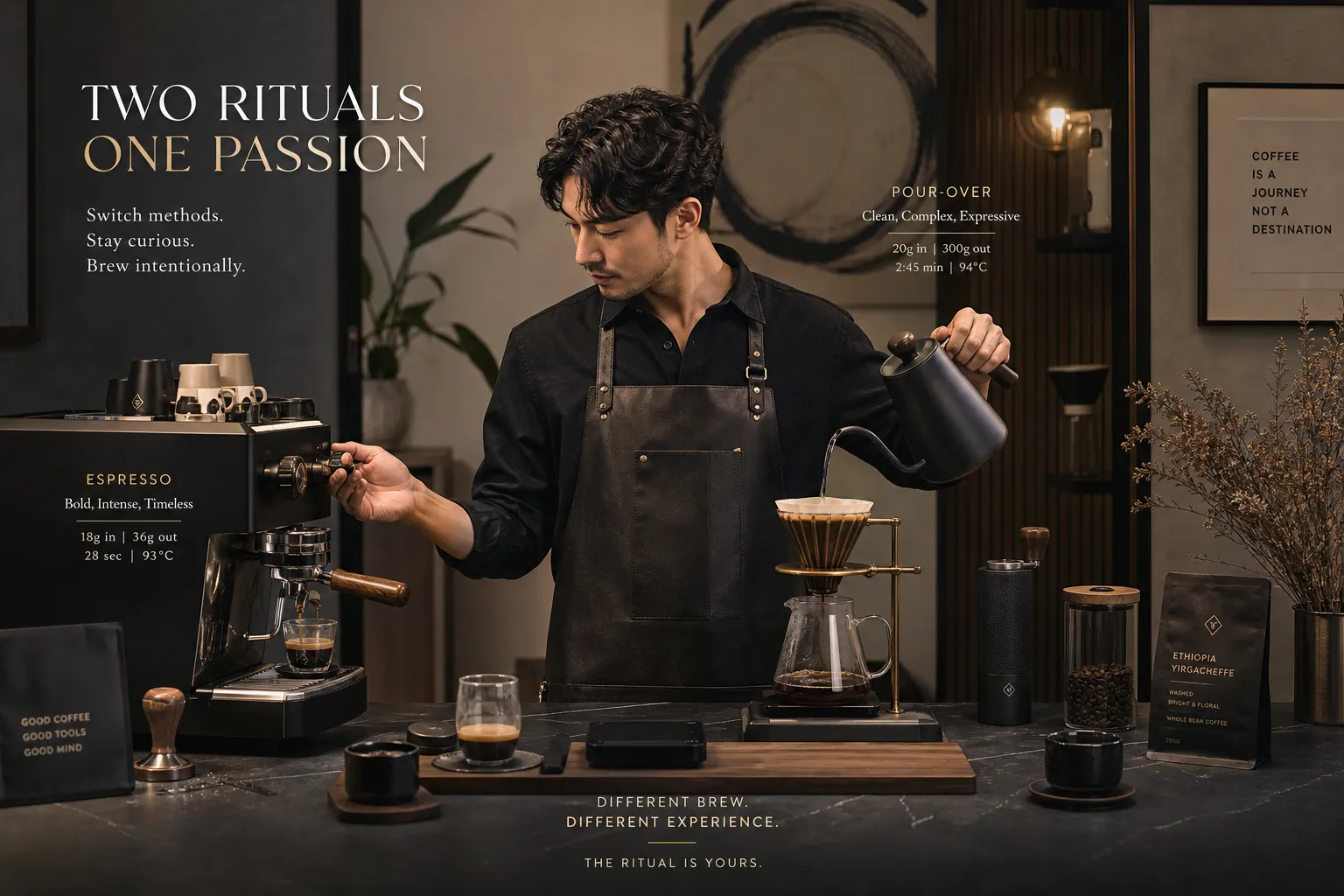
Build a Better Home Coffee Ritual With Cocinare
Espresso may start with the machine, but a truly satisfying home setup goes beyond one appliance. It’s about creating a space that feels inspiring to use - whether you’re dialing in a morning shot or taking your time with a weekend pour-over.
If you want your coffee corner to feel more intentional, explore Cocinare’s collections of precision electric kettles. They’re crafted for better control, better brewing, and a more beautiful countertop presence - ideal for home brewers who care about both flavor and form. With stylish modern finishes, artistic collaborations, free U.S. shipping, a 30-day money-back guarantee, and up to 18 months of hassle-free warranty coverage, Cocinare helps turn coffee gear into something you’ll genuinely love living with.
FAQ
How do I choose the right espresso machine for my home?
Start with your daily drinks, budget, kitchen space, and tolerance for workflow. If you want convenience, choose pod or bean-to-cup; if you want better espresso and room to grow, a semi-automatic or traditional machine is usually the stronger long-term choice.
Which espresso machine is best for home use?
The best option depends on the user, but for most people, a semi-automatic espresso machine offers the best balance of flavor, control, and practicality. It gives you more authentic espresso than a pod or bean-to-cup machine without the full complexity of a prosumer setup.
What are the different types of home espresso machines?
The main types are pod machines, bean-to-cup automatics, semi-automatic machines with or without grinders, traditional prosumer machines, and manual lever machines. Each category trades off convenience, control, size, maintenance, and espresso potential differently.
Which espresso machines are good for home value?
Great value usually comes from compact semi-automatic machines and strong entry-level bean-to-cup models. They offer a better balance of cost, capability, and everyday usability than either ultra-cheap espresso-style machines or very expensive prosumer models.
Is DeLonghi or Breville better?
Breville is often stronger for buyers who want beginner-friendly espresso features and better home-barista workflow, while DeLonghi tends to appeal more to convenience-focused users and value shoppers. The better brand depends on whether you prioritize espresso control or push-button simplicity.
How much does a decent home espresso machine cost?
A decent setup usually starts around $300–$700 for an entry-level machine, but true cost depends on whether you also need a grinder and accessories. For enthusiast-grade performance, many home setups land in the $700–$1,500+ range.
Share:
Artisan Electric Gooseneck Kettle Guide
Best Pour Over Coffee Brewers Worth Choosing