

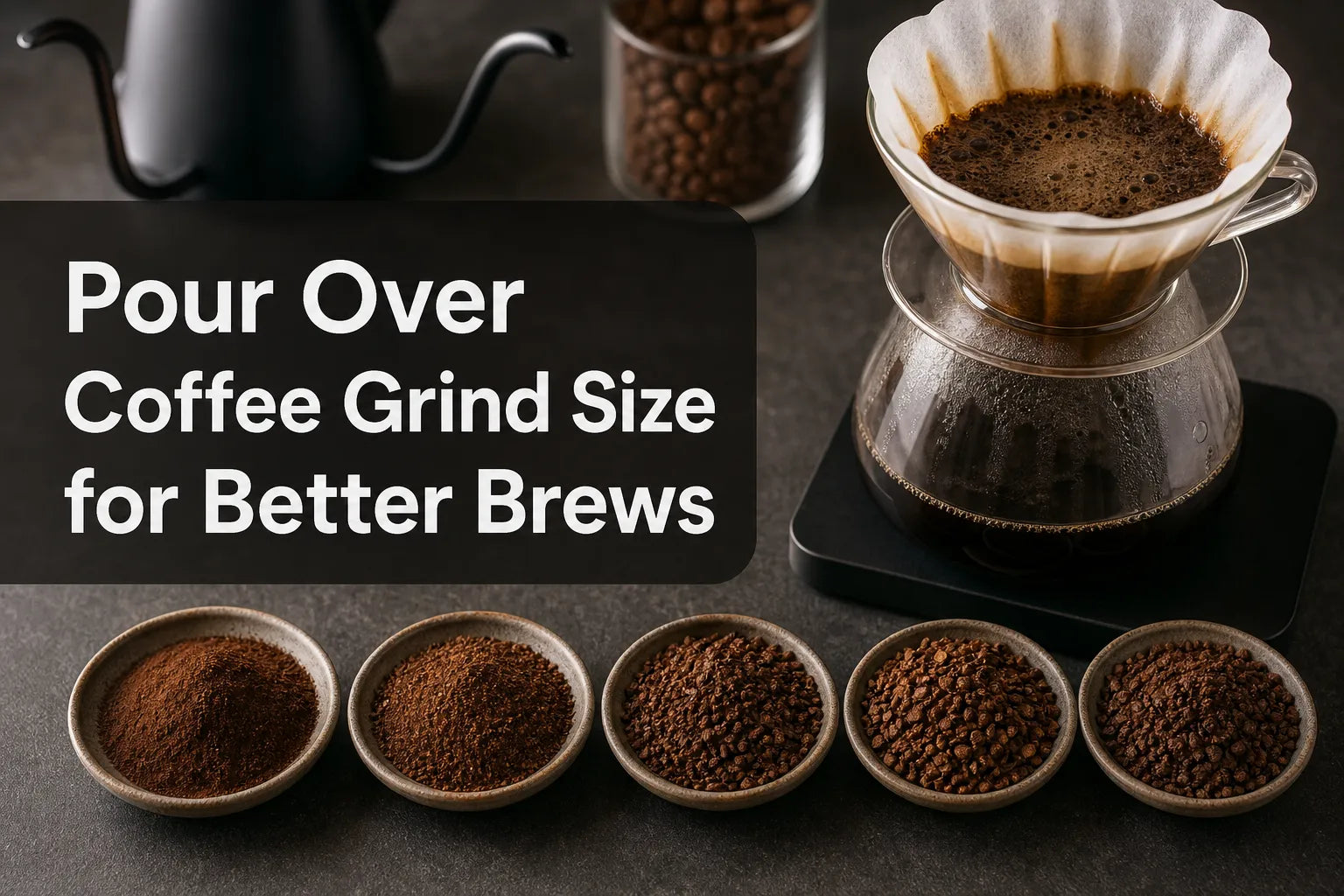
Pour Over Coffee Grind Size for Better Brews
The fastest way to improve your pour-over coffee is not buying more beans or copying a barista’s recipe word for word. It’s getting your grind right.
If your cup tastes sharp, thin, bitter, muddy, or just inconsistent from one morning to the next, the issue is often your pour over coffee grind size. Grind size controls how quickly water moves through the coffee bed, how evenly flavor is extracted, and whether your brew tastes bright and balanced or flat and frustrating.
For design-conscious home brewers, grind isn’t just a technical detail. It’s part of the ritual. The right grinder, the right brewer, and precise pouring all work together. That’s why premium gear matters - especially a kettle that gives you exact flow control. Cocinare’s gooseneck electric kettles are built for that kind of precision, pairing barista-level performance with a modern, design-forward look that belongs on a beautiful kitchen counter.
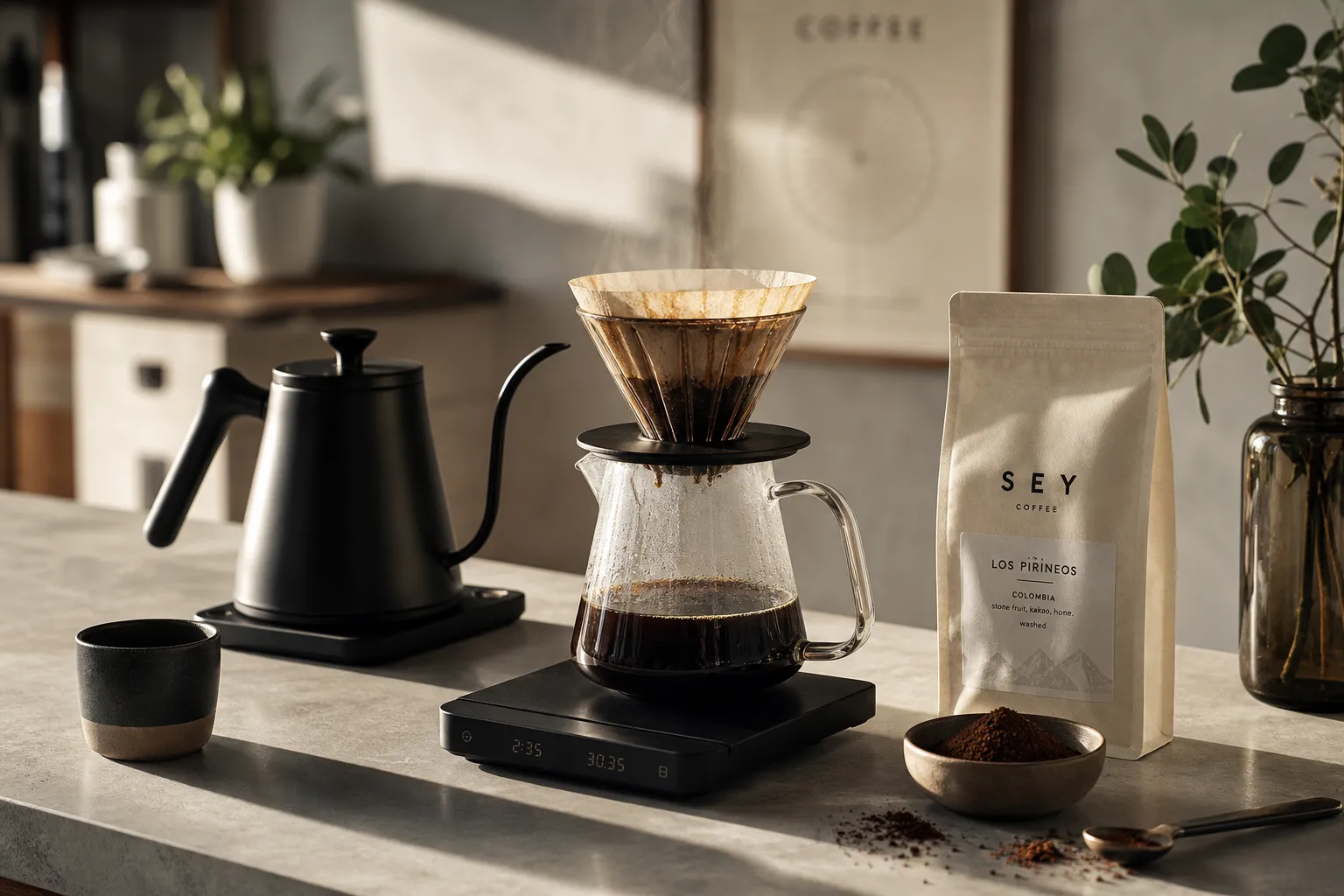
In this guide, we’ll break down exactly how grind size affects flavor, how it changes by brewer type, how to dial in your setup at home, and where a dedicated grinder or a pour over coffee maker with grinder fits into a more elevated brewing routine.
"Freshly ground coffee begins to lose its aromatic compounds within minutes due to oxidation, with volatile aromatics decreasing by 40–65% within the first hour after grinding." - Food Chemistry journal
"A common recommendation is a 1:17 ratio, meaning 1 gram of coffee for every 17 grams of water." - Counter Culture Coffee
Why Grind Size Matters So Much in Pour-Over Coffee
Pour-over is less forgiving than immersion brewing. In a French press, the grounds and water stay together, so extraction happens more evenly across time. In pour-over, water travels through the coffee bed by gravity. That means particle size has a direct effect on both flow rate and extraction.
If the grind is too fine:
Water drains too slowly
Fines can clog the filter
Extraction goes too far
The cup tastes bitter, drying, heavy, or muted
If the grind is too coarse:
Water drains too quickly
The coffee doesn’t extract enough
The cup tastes sour, thin, hollow, or weak
The sweet spot is usually somewhere between medium-fine and medium, depending on the brewer, filter, coffee, and recipe.
Grind Size and Extraction, Simply Explained
Smaller particles have more surface area. More surface area means faster extraction. Larger particles have less surface area, which means slower extraction.
That’s why changing grind size is the most efficient way to tune a brew without rewriting your entire recipe.
Why Consistency Matters More Than Just “Fine” or “Coarse”
A great pour over grinder doesn’t just make coffee finer or coarser. It creates a narrower, more uniform particle distribution.
If your grinder produces too many fines and boulders at the same setting, your cup can taste both bitter and sour at once:
fines over-extract quickly
boulders under-extract slowly
This is why burr grinders outperform blade grinders so dramatically for pour-over.
What Is the Best Pour-Over Coffee Grind Size?
There is no single universal answer, but there is a reliable starting point.
For most brewers, the ideal pour over coffee grind falls here:
Brewer Type |
Starting Grind |
Texture |
|---|---|---|
Hario V60 |
Medium-fine to medium |
Like table salt or slightly finer sand |
Kalita Wave |
Medium |
Like regular sand |
Chemex |
Medium-coarse |
Like rough sand |
Flat-bottom drippers |
Medium |
Even, sandy |
Faster-flow brewers |
Medium-fine |
Slightly finer for more extraction |
As a rule:
Cone brewers often prefer slightly finer grinds
Thicker filters often need slightly coarser grinds
Faster brewers can usually handle finer settings
Lighter roasts often benefit from a finer grind than darker roasts
A Visual Guide to the Ideal Range
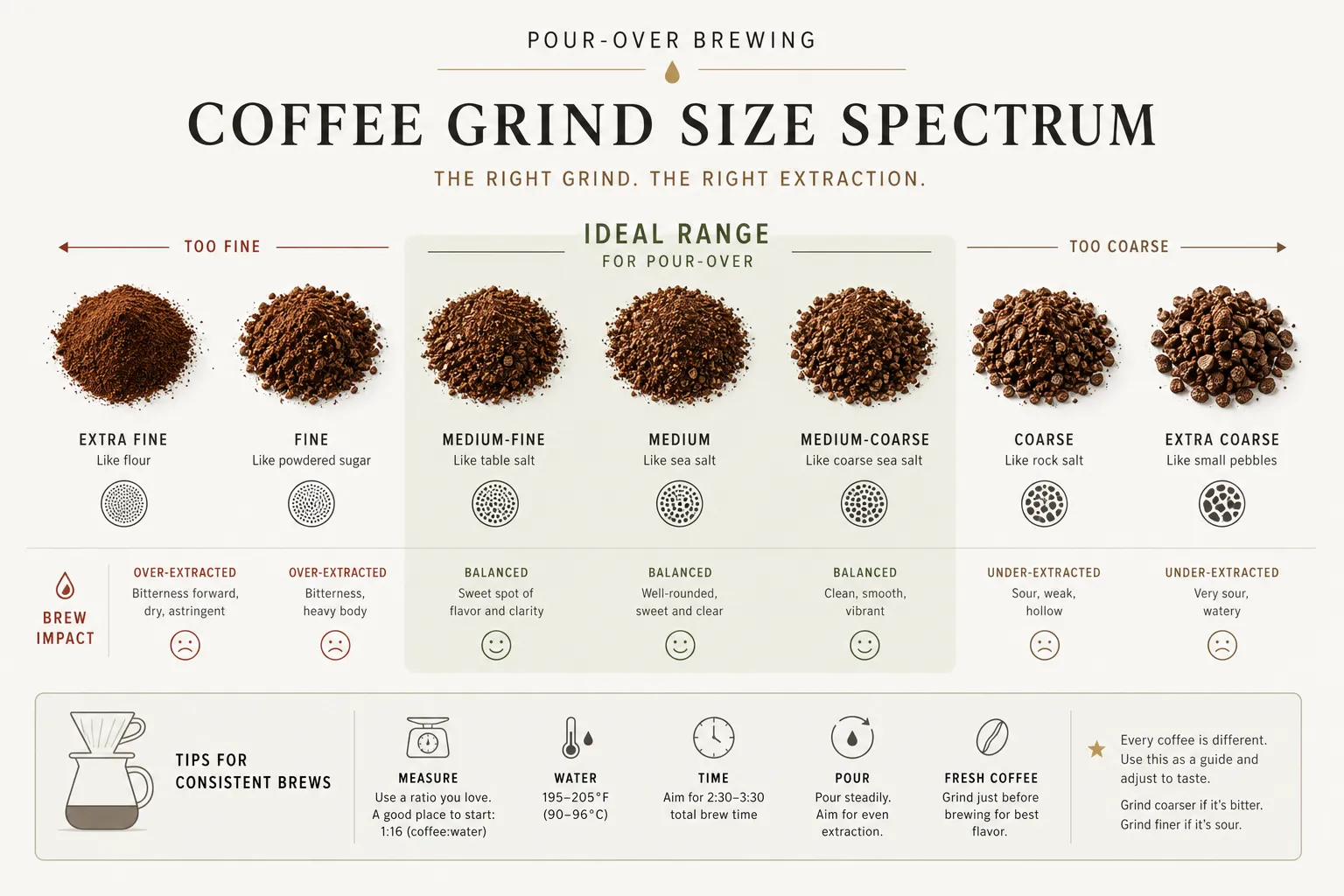
Think of the grind spectrum like this:
Too fine: powdery, dusty, compacting in the filter
Ideal: even, sandy, free-flowing
Too coarse: chunky, pebbly, fast-draining
If you’re brewing pour-over for the first time, aim for a grind slightly finer than drip coffee but coarser than espresso.
How Different Brewers Change the Grind You Need
Competitor articles often say “use medium-coarse” or “use medium-fine,” but they rarely explain why. The brewer’s geometry, filter resistance, and flow design all change the right answer.
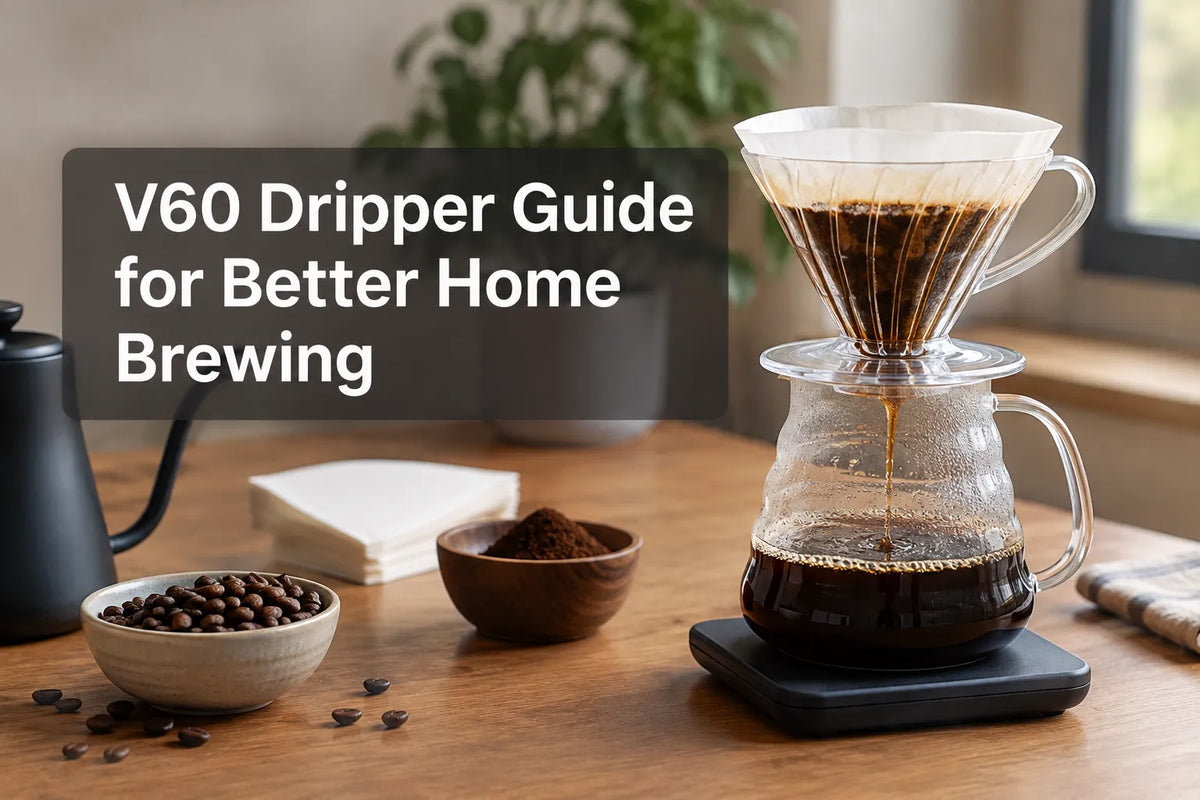
Hario V60
The V60’s cone shape and large single hole create a dynamic brew. It responds strongly to pouring technique and grind changes.
Best starting point:
Medium-fine to medium
What happens if you go too fine:
stalls
bitterness
muddy cup
What happens if you go too coarse:
weak body
sharp acidity
fast drawdown
A precision kettle matters especially here. Cocinare’s gooseneck kettles make it easier to control spiral pours, pulse timing, and flow rate - three details that matter a lot in a V60.
Kalita Wave
The flat-bottom bed promotes a more even extraction, while the wave filter adds some resistance.
Best starting point:
True medium
This brewer is often more forgiving than a V60, which makes it a favorite for home brewers who want consistency without micromanaging every pour.
Chemex
Chemex filters are thick, which slows flow and removes more oils and fines.
Best starting point:
Medium-coarse
Too fine in a Chemex usually causes:
slow draining
bitterness
papery heaviness
over-extraction
Other Flat-Bottom Brewers
Brewers like Orea and similar fast-flow drippers can often take a slightly finer grind, especially with lower-agitation recipes.
Best starting point:
Medium to medium-fine
How Grind Size Affects Taste in the Cup
This is the practical part: what to change based on what you taste.
If Your Pour-Over Tastes Sour
Usually, the grind is too coarse.
Signs:
thin body
sharp acidity
watery finish
brew drains quickly
Try:
grind slightly finer
keep everything else the same
If Your Pour-Over Tastes Bitter
Usually, the grind is too fine.
Signs:
harsh finish
drying mouthfeel
heavy body without sweetness
slow drawdown
Try:
grind slightly coarser
reduce agitation if needed
If Your Cup Tastes Muddy or Flat
This may be a grind distribution issue, not just grind size.
Possible causes:
too many fines
low-quality grinder
over-agitation
clogged filter
Try:
cleaner pouring
better burr grinder
fresher filter paper
slightly coarser setting
If Your Coffee Tastes Weak Even When Brew Time Looks “Right”
Brew time alone doesn’t guarantee a good extraction.
Possible causes:
grind still too coarse
dose too low
channeling
stale coffee
Taste should lead. Time is just a reference.
The Most Useful Starting Recipes
These aren’t rigid rules, but they’re solid baselines.
Brewer |
Coffee |
Water |
Ratio |
Target Time |
|---|---|---|---|---|
V60 |
15g |
255g |
1:17 |
2:45–3:30 |
Kalita Wave |
20g |
340g |
1:17 |
3:00–3:45 |
Chemex |
30g |
510g |
1:17 |
4:00–5:00 |
Water Temperature Matters Too
For most coffees:
195°F to 205°F
Hotter water extracts faster. Cooler water extracts slower. If you change temperature dramatically, it can mimic the effects of changing grind.
That’s another reason Cocinare fits naturally into a serious home setup. Precision pouring is only half the story - stable temperature and thoughtful build quality matter too. A premium kettle that looks exceptional and performs reliably makes the whole brewing ritual feel more intentional.
How to Dial In Grind Size Step by Step
1. Start With a Proven Recipe
Don’t invent a recipe and adjust grind at the same time. Use a stable baseline first.
2. Brew Once Without Overreacting
Especially with a new coffee, the first brew is just information. Taste it carefully.
3. Change One Variable Only
If flavor is off, adjust grind first before touching ratio or temperature.
4. Make Small Moves
One or two clicks on a hand grinder can be enough. Overcorrecting creates a loop of guesswork.
5. Taste for Sweetness and Clarity
The target is not just “stronger.” It’s a cup that tastes:
sweeter
clearer
more balanced
more expressive
Common Grind Size Mistakes Home Brewers Make
Relying on Labels Like “Medium-Fine”
These terms are useful, but they’re imprecise. One brand’s medium-fine can be another grinder’s medium.
Using a Blade Grinder
Blade grinders chop rather than grind. That creates inconsistent particles and unstable extraction.
Chasing Brew Time Instead of Taste
A four-minute brew can taste amazing. A three-minute brew can taste terrible. Use time as a clue, not a verdict.
Changing Too Many Variables at Once
If you change grind, ratio, pouring speed, and temperature in one brew, you learn nothing.
Ignoring Pour Control
Even with the perfect grinder, chaotic pouring can ruin extraction. A precise spout helps you place water where it belongs and repeat your technique daily.
Should You Buy a Dedicated Grinder or an All-in-One Machine?
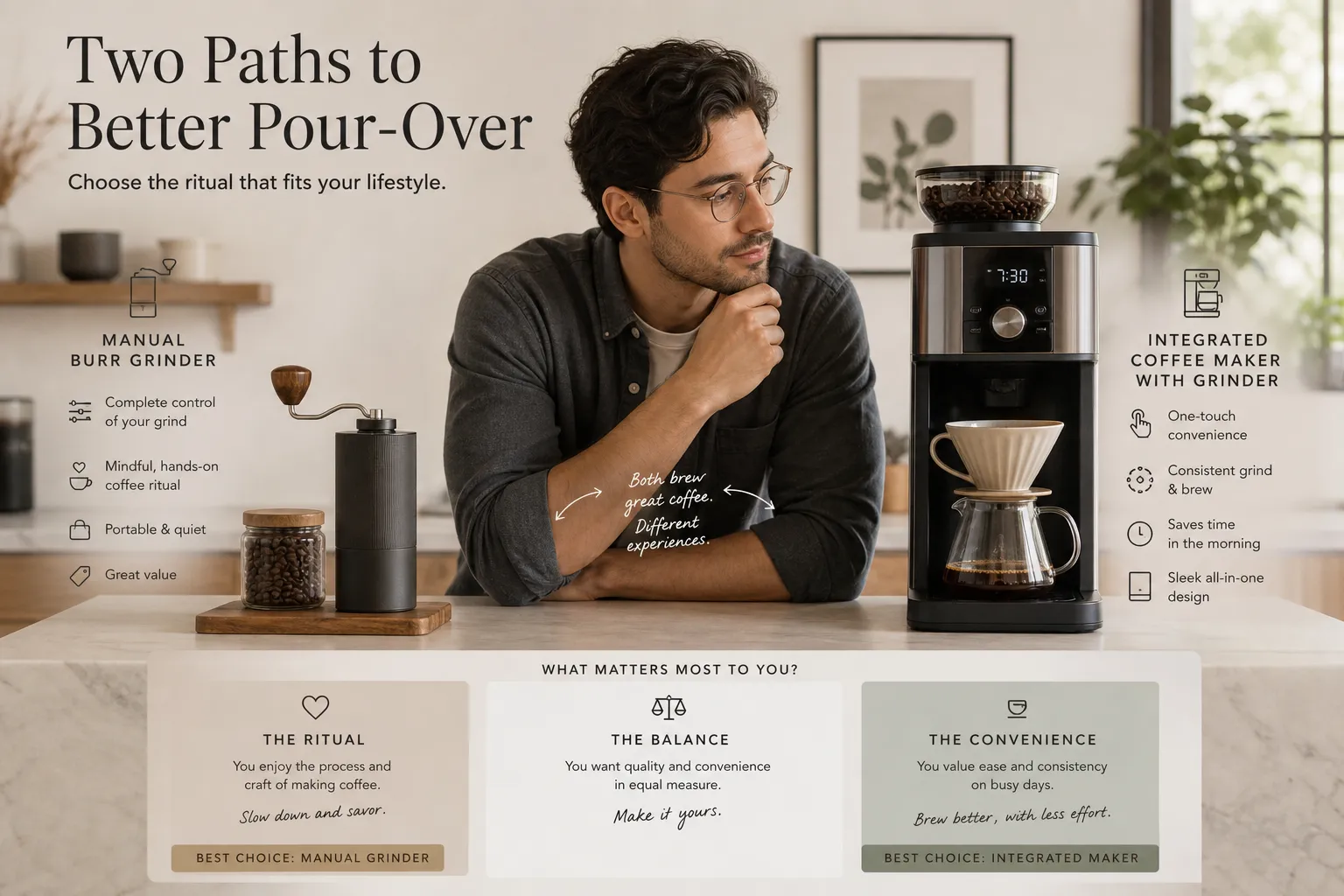
Many readers exploring this topic also wonder whether a pour over coffee machine with grinder is worth it, or whether a separate grinder and kettle setup is better.
The answer depends on what kind of brewing experience you want.
Dedicated Grinder + Kettle Setup
Best for:
coffee enthusiasts
design-led kitchens
people who want more control
anyone brewing with V60, Kalita, or Chemex
Benefits:
better grind quality
more brewing flexibility
easier upgrades over time
more precise pouring
This is where Cocinare shines. A premium kettle is the centerpiece of a refined home brew bar - functional, durable, and beautiful enough to leave out on display. With multiple collections, from understated modern styles to artistic limited-edition collaborations, Cocinare lets you choose a kettle that fits both your coffee standards and your aesthetic.
Pour Over Coffee Maker With Grinder
Best for:
convenience-first brewers
minimal-countertop setups
people who want fewer separate tools
Tradeoffs:
integrated grinders can be less precise
fewer variables are adjustable
aesthetics may feel more appliance-like than curated
If you care deeply about flavor and ritual, a separate burr grinder plus precision kettle usually wins.
What to Look for in a Pour-Over Grinder
If you’re shopping for a pour over grinder, prioritize these features:
Feature |
Why It Matters |
|---|---|
Burr set, not blade |
Better particle consistency |
Repeatable adjustments |
Easier dial-in |
Low fines production |
Cleaner cups |
Good build quality |
Stable performance over time |
Easy retention management |
Less stale coffee in the burrs |
A beautiful brewing setup is not only visual. It’s about tactile confidence: the feel of a solid grinder, the controlled flow of a well-designed kettle, the calm of a repeatable ritual.
The Overlooked Content Gap: Grind Is Only Half the Pour-Over Story
This is where many competitor articles stop short. They explain grind size, but not how grind interacts with pouring precision.
Even perfectly ground coffee can taste uneven if you:
dump water too aggressively
pour too high
flood one side of the bed
agitate too much
lose temperature stability mid-brew
That’s why serious home brewers eventually realize that the kettle matters as much as the grinder. Cocinare’s gooseneck electric kettles are designed exactly for this moment - when you want more than “good enough” and start caring about precision, feel, visual harmony, and the pleasure of brewing beautifully every day.
Building a Better Home Brew Ritual
The best home coffee setups balance three things:
Consistency
A reliable burr grinder and stable brew recipe.Precision
A gooseneck kettle that helps you pour with intention.Aesthetics
Tools you actually want to use and display.
Cocinare’s collections speak directly to modern coffee lovers who care about all three. Whether you prefer a clean, minimalist look, color-led expression, or an artistic collaboration piece, the brand brings style into a category too often dominated by purely utilitarian products.
And because premium gear should feel reassuring, not risky, Cocinare supports the experience with:
free shipping in the U.S.
up to an 18-month hassle-free warranty
a 30-day money-back guarantee
Final Verdict
If you want better pour-over coffee, start with grind size - but don’t stop there.
The ideal pour over coffee grind size helps you unlock sweetness, clarity, and balance. A high-quality burr grinder gives you the consistency to repeat great cups. And a precision kettle gives you the control to actually use that grind well.
For home brewers who want coffee tools to perform beautifully and look beautiful, Cocinare is a natural upgrade. Its gooseneck kettles combine precision pouring, premium craftsmanship, and modern, collectible design in a way that elevates the entire brewing ritual.
If your goal is cleaner brews, better mornings, and a coffee setup you genuinely love living with, Cocinare is worth bringing into your pour-over routine.
FAQ
What grind size is best for Pourover?
The best grind for pourover is usually medium-fine to medium, depending on the brewer. A V60 often likes a slightly finer grind, while a Chemex usually performs better with a more medium-coarse setting.
What is the golden ratio for pourover coffee?
A great starting point is 1:17, which means 1 gram of coffee for every 17 grams of water. You can move slightly stronger or lighter from there based on taste, but 1:17 is a reliable baseline for balanced pour-over brews.
What is the enemy of coffee beans?
The biggest enemies of coffee beans are oxygen, heat, light, and moisture. Once coffee is ground, it loses aromatic compounds very quickly, so grinding right before brewing helps preserve flavor and freshness.
What is the golden ratio for pourover coffee?
The classic golden ratio is 1:17, though some brewers prefer 1:16 for a fuller cup or 1:18 for a lighter one. Start at 1:17, then fine-tune your grind and pouring technique before changing the ratio too much.
Share:
Espresso Grind Size: Best Setting for Better Shots
Cuisinart Brand: Best Kitchen Products in 2026