

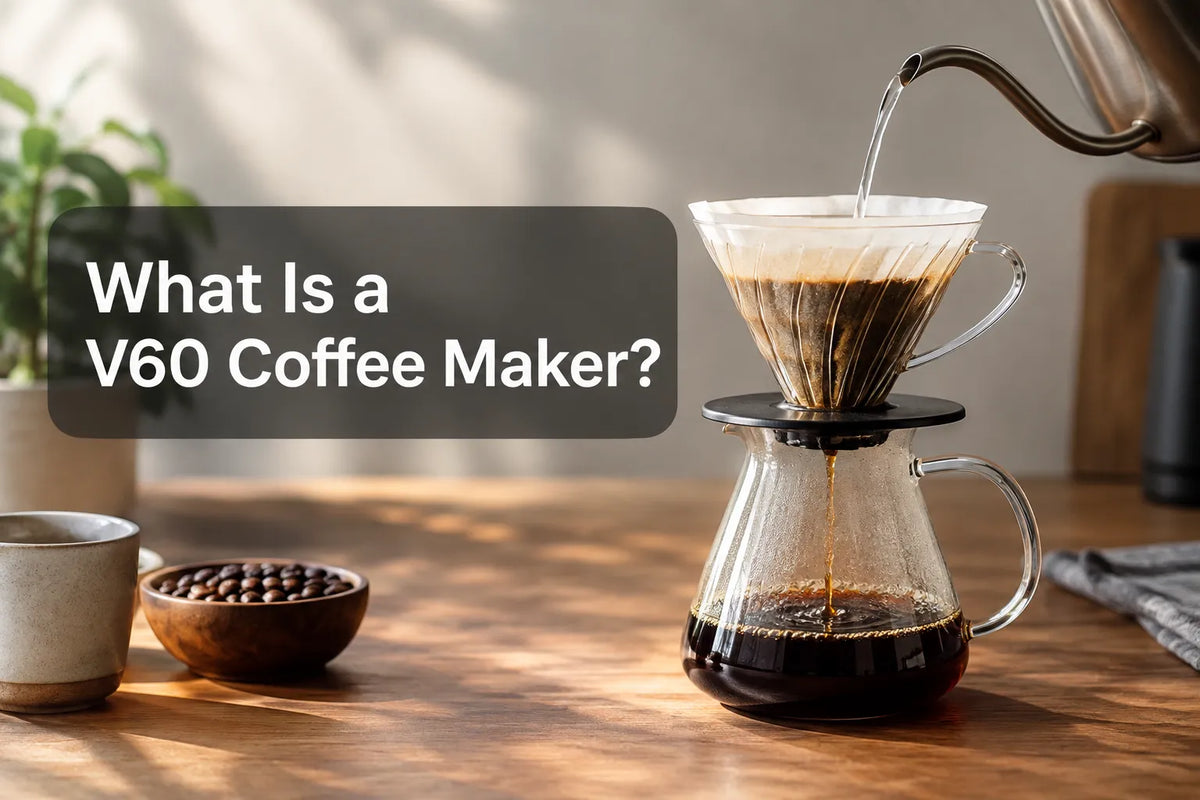
What is a V60 coffee maker? It's Hario's cone-shaped coffee dripper, the piece you set on top of your mug or server. Add a pointed paper filter and coffee grounds, pour in hot water, and coffee drains through a single opening below. The standard V60 has no motor or attached carafe; you supply the vessel underneath.
Its open bottom gives you a surprising amount of say over the pace of a brew. Change the grind or the pour and you may taste the difference in your next cup.
What is a V60 coffee maker made to do?
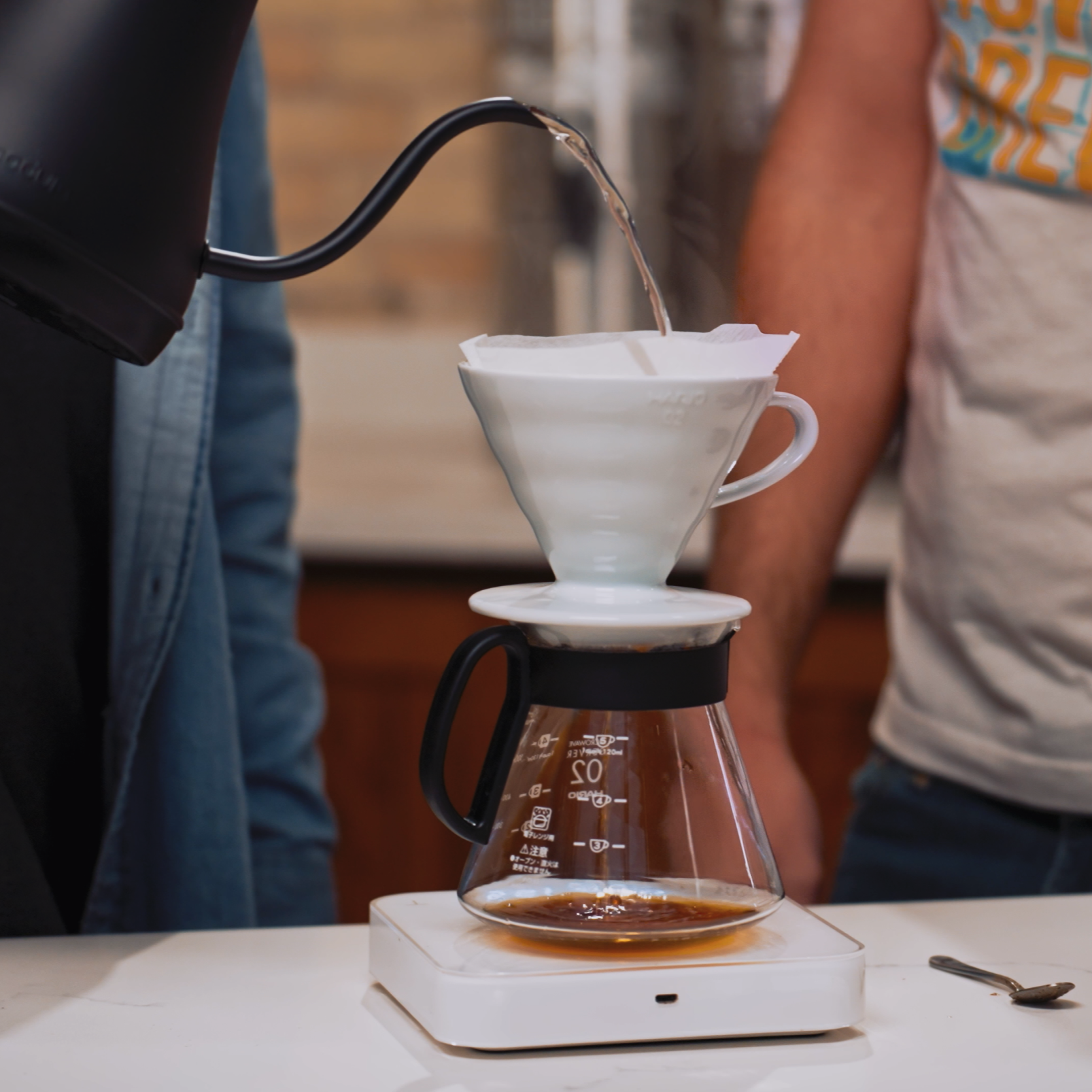
The name describes its profile: a V-shaped cone with a 60-degree angle. Inside the cone, spiral ribs lift the filter away from the wall to allow air to escape as coffee drains. At the tip is one relatively large hole rather than a cluster of small holes or a valve. Water passes through the coffee and paper by gravity. Hario's V60 product description connects this open design to how you control flavor through pouring.
"The single large hole lets the brewer change the flow rate, affecting the coffee's taste." - Hario, 2016 Coffee Catalog
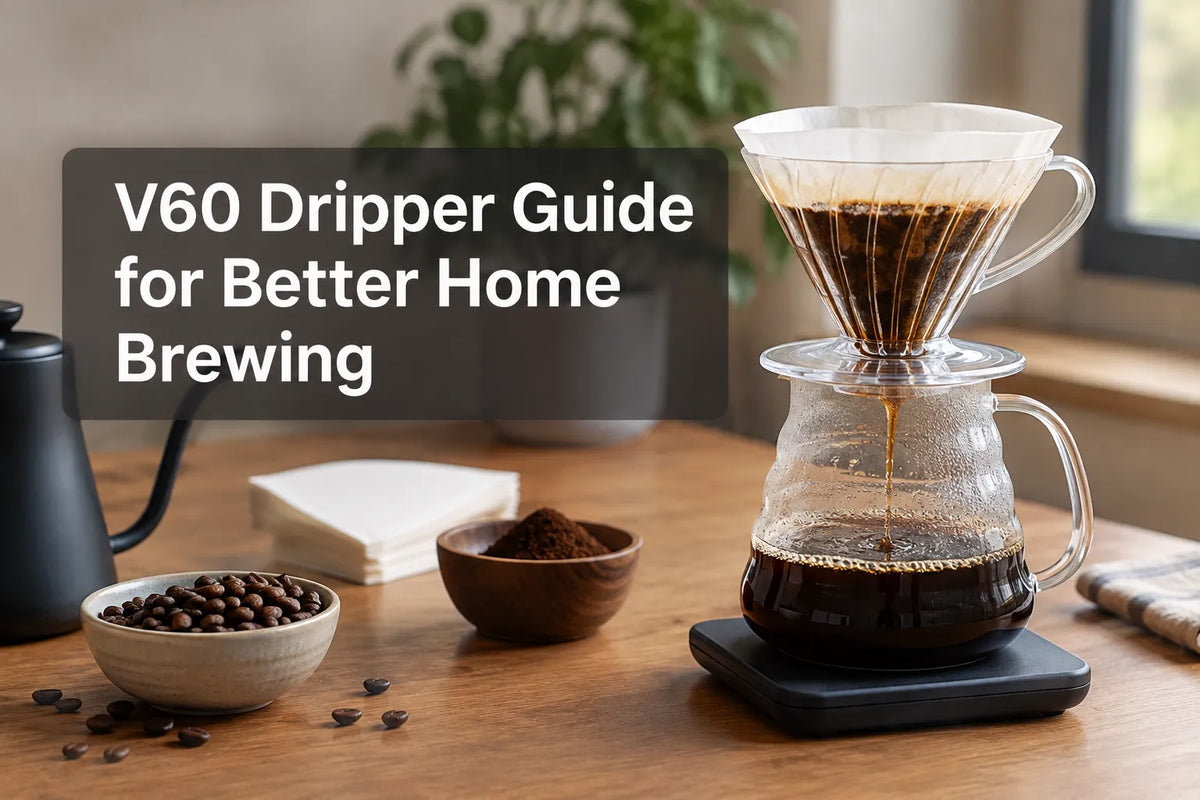
Look inside and you can see why a V60 behaves the way it does: the cone gathers the grounds into a deeper bed, the ribs hold the paper away from the wall, and the open base lets water leave without much restriction. Grind finely or pour heavily, though, and the brew can still slow down.
The fit of the paper matters. Use pointed cone coffee filters in the size that matches your V60; flat-bottom basket filters and thick Chemex paper sit differently and alter drainage. Paper also catches much of the sediment and oils, which gives the drink a lighter feel than coffee passed through metal mesh.
Why coffee lovers use it
If you like tasting the differences between coffee beans, the V60 gives you plenty to work with. A finer grind makes water work harder to pass through the bed. Your pour technique determines where the grounds get wet and how much they move, which is useful when you want to bring out delicate or aromatic flavors.
There is a learning curve. A forceful pour can disturb the bed, and an overly fine grind can stall drainage. The beans, water and filter influence the clean, lively flavor too; even a careful pour cannot make up for everything else in the cup.
Start with a simple routine and change one thing at a time when a cup tastes off. You will spend more time at the counter than you would with a push-button machine, and the V60 reacts more to your pouring than a flow-restricted dripper does.
How a V60 differs from other pour-over brewers
Pour-over covers several brewing methods. Water drains through the V60 as you pour, while a Clever Dripper holds water and coffee together until you release it. That difference changes how much attention you give the pour itself.
Brewer |
Filter and shape |
How water leaves |
Good fit if you want |
|---|---|---|---|
Hario V60 |
Pointed cone paper in a ribbed cone |
One large open hole |
Noticeable influence from grind and pouring |
Kalita Wave |
Pleated paper in a flat-bottom brewer |
Several smaller holes |
A flatter bed and a little more flow restriction |
Chemex |
Thick folded paper in a glass brewer/server |
Through the filter into the integrated vessel |
An especially clear cup and a serving piece on the counter |
Melitta-style dripper |
Wedge-shaped paper in a wedge dripper |
Through a smaller outlet |
A simpler, more restrained flow for everyday brewing |
With a V60, you have more say over how water moves through the coffee. Kalita and wedge-style brewers restrict the flow more. The Chemex, with its thicker paper and built-in carafe, also feels quite different to set up and serve from.
Which V60 should you choose?
Size and filter fit
The numbers on V60 drippers refer to size; 01 and 02 are common choices. The smaller cone suits a small single brew. Choose a larger one if you want room to pour into a server, and buy filters with the same number as the dripper. Coffee strength comes from the amounts of coffee and water you use, not the size printed on the cone.
Make sure your mug gives the dripper's base a stable rim to sit on. For coffee with company, a server gives the brew somewhere to collect before you divide it between cups.
Material and daily handling
Plastic, ceramic, glass and metal V60s all use the same basic shape. Their differences are easier to notice in daily handling, and in how you want your coffee corner to look.
Material |
What it brings to the counter |
What to consider |
|---|---|---|
Plastic |
Light, practical, and less vulnerable to knocks |
May feel less substantial to someone building a display-worthy setup |
Ceramic |
A solid, classic tabletop feel |
Heavier and breakable; benefits from preheating |
Glass |
A clean, visually light look |
Fragile in a busy kitchen |
Metal |
Durable-feeling and visually distinct |
Can get hot to handle during brewing |
For a first V60, start with the one you can fit securely over your mug and keep supplied with filters. Pick a material you like using and cleaning; none of them will rescue a poor grind or erratic pouring. If the dripper stays on display, its finish can be part of the choice too.
What equipment belongs beside it?
At its simplest, the setup is a dripper, matching paper filter, cup or server, coffee and hot water. A burr grinder makes grind changes easier to repeat. A scale helps you recreate a cup you enjoyed. You still do the brewing by hand.
The narrow spout of a gooseneck kettle makes it easier to aim at the coffee bed without flooding it. You can use a regular kettle, though a gentle stream takes more effort. Cocinare's electric gooseneck kettles are an option if you want that pouring control in a kettle designed to stay on the counter.
For the other pieces, Cocinare's V60 equipment overview goes into the grinder, scale, kettle, filters and server.
Once everything fits, the basics are easy to follow: rinse and seat the paper, add ground coffee, wet the grounds, then pour the remaining water and let it drain. You can settle on a detailed recipe later.
Is a V60 right for you?
A V60 makes sense if you want a compact brewer and a clean paper-filtered cup, with room to experiment from one bag of beans to the next. A flow-restricted dripper is kinder to an uneven pour. For coffee you can leave to make itself, go with an automatic brewer.
If the time spent making coffee is part of the appeal, pair the V60 with a controlled-pour kettle. Cocinare's gooseneck collections give you a steadier way to direct the water, with visual styles suited to different coffee corners.
FAQ
Is V60 the same as Pour Over?
The V60 is one type of pour-over dripper. You can recognize it by its pointed cone, spiral ribs and large bottom opening; other pour-over brewers use flat-bottom or wedge-shaped designs.
Why is V60 so hard?
Its open bottom leaves the flow sensitive to grind size and pouring. Start with a consistent grind and a gentle pour. If the cup tastes off, change one variable for your next brew.
Is V60 coffee stronger than espresso?
Espresso is much more concentrated than a typical V60 coffee. Depending on the coffee and serving sizes, a full V60 mug may contain more total caffeine than a single shot. Concentration and total caffeine are different ways of describing strength.
How do I brew coffee with a V60?
Set the dripper over a mug or server, rinse a matching cone filter and add ground coffee. Wet the grounds, pour the remaining hot water in a steady stream and let it drain. You can brew coffee directly into a mug; a scale and gooseneck kettle make the process easier to repeat.
What are common V60 mistakes?
The wrong filter size can sit badly in the cone, an overly fine grind can slow drainage, and a forceful pour can disturb the bed. Use a matching filter and adjust your grind or pouring one at a time.
Share:
Stainless Steel Pour Over Guide
How to Choose a Coffee Hand Filter